
Exclusive eBook
Legacy That Lasts
A Real Estate Approach to Generational Wealth
Scroll Down To Access The eBook

Key Points Covered In The eBook

Table Of Contents
- Introduction: Unveiling the Potential of Multifamily Real Estate for Legacy Wealth Planning
- Chapter 1: Building a Legacy with Multifamily Real Estate
- Chapter 2: The Resilience and Tax Benefits of Multifamily Real Estate
- Chapter 3: Getting Started in Multifamily Real Estate for HNWIs
- Chapter 4: Your Legacy, Made Simple With WestKey Capital
- Conclusion: Your Journey to Building a Lasting Legacy with WestKey Capital
- Intro
- Chapter 1
- Chapter 2
- Chapter 3
- Chapter 4
- Conclusion
Introduction: Unveiling the Potential of Multifamily Real Estate for Legacy Wealth Planning
Building a legacy that extends for generations is more than just a financial goal—it is a powerful strategy that ensures the wealth you create today continues to provide long-term financial security for your family. Multifamily real estate has proven itself to be one of the most reliable vehicles for generating enduring wealth, offering a combination of consistent cash flow, valuable tax benefits, and long-term asset appreciation.

In this eBook, we’ll explore how multifamily real estate can become the cornerstone of your legacy wealth strategy. By leveraging its stability, resilience, and the ability to generate passive income, multifamily properties can seamlessly integrate into your broader financial plan, ensuring that your wealth withstands market volatility and benefits your descendants for generations to come.
Are you ready to start building your legacy?
Schedule a free consultation to discover how multifamily real estate can help you reach your financial objectives!
Chapter 1: Building a Legacy with Multifamily Real Estate
Understanding Legacy Wealth
True legacy wealth is not just about accumulating financial resources; it’s about establishing a sustainable system that supports your heirs, equipping them with both tangible assets and the financial acumen to manage and grow that wealth. Multifamily real estate is one of the most effective ways to build a resilient, intergenerational wealth structure that transcends the challenges of economic fluctuations.
The goal is to build not only wealth but also a legacy—one that encompasses financial independence, ongoing income, and the wisdom to ensure future generations thrive without starting from scratch. Through strategic investments in multifamily real estate, your family can access a portfolio that consistently produces income and appreciates over time, securing their financial future and expanding wealth with each passing generation.

The Role of Multifamily Real Estate in Legacy Building
Multifamily real estate offers a rare combination of features that make it an invaluable tool in building lasting wealth. It offers consistent cash flow, solid asset appreciation, and the opportunity for diversification—all of which combine to provide a level of financial security that other asset classes, such as stocks or single-family properties, cannot deliver.
- Reliable Cash Flow: Multifamily properties generate consistent passive income streams, even during times of vacancy. This ensures that your family’s wealth continues to grow, regardless of economic conditions.
- Scalability and Growth: Start with a smaller property and, as your portfolio grows, expand by acquiring more units. The scalability of multifamily real estate allows investors to exponentially increase their returns over time.
- Appreciation Over Time: Multifamily properties tend to increase in value due to steady demand for rental housing, capital improvements, and well-executed property management. With its proven appreciation, multifamily real estate provides a reliable long-term asset for your legacy.
Types of Multifamily Acquisitions
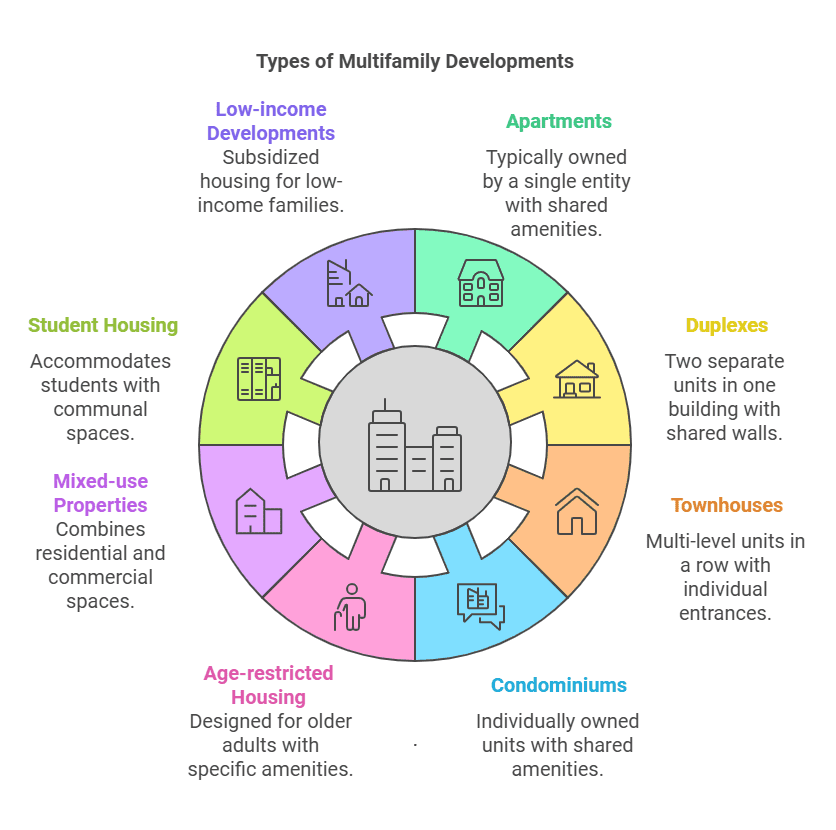
There are various types of multifamily properties that can add strength and diversity to your investment portfolio, including:
- Low-Income Developments: These properties provide subsidized housing, ensuring stable demand and offering investors consistent rental income.
- Student Housing: Located near universities, these properties offer strong rental yields due to high student demand.
- Mixed-Use Properties: These combine residential and commercial spaces, providing multiple income streams, which further diversify the investment.
- Age-Restricted Housing: Properties designed for seniors, with specialized amenities, attracting a reliable and often long-term demographic.
These types of properties provide unique opportunities to build a resilient and diversified real estate portfolio that can weather economic changes.
The U.S. Multifamily Real Estate Market in 2025
The multifamily real estate market in 2025 is projected to experience stabilization and modest growth, influenced by key factors such as:
- Rent Growth: National rent growth is expected to recover slowly, reaching approximately 4% by 2026 as the supply of new units slows down and demand stabilizes. Read More
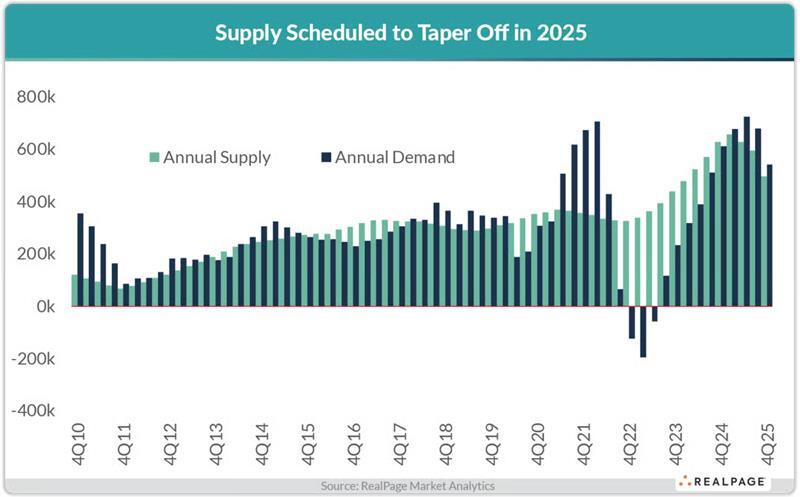
- Investment Activity: Despite economic uncertainties, investor confidence remains strong, with multifamily transaction volume projected to reach $370 billion to $380 billion in 2025. Read More
Multifamily New Construction Slowdown
Due to rising inflation and tariffs on building materials, the construction of new multifamily properties has slowed. The National Association of Home Builders (NAHB) reports an increase in construction expenses by $9,200 per home, while high interest rates further strain development budgets. Read More
As fewer new units enter the market, the demand for existing multifamily properties increases, driving up property values and rental prices. This creates a strong opportunity for investors, as established properties offer immediate cash flow, lower risks, and faster returns compared to newly developed properties.
Chapter 2: The Resilience and Tax Benefits of Multifamily Real Estate
Multifamily Real Estate: A Stable Investment Amid Economic Fluctuations
Building generational wealth requires laying a foundation that remains strong even in times of economic uncertainty. Multifamily real estate stands out as a proven and reliable asset class that holds its value and generates income during economic downturns.
Unlike volatile investments like stocks or bonds, multifamily real estate offers consistent cash flow, long-term value appreciation, and significant tax-saving strategies—key elements for crafting a lasting financial legacy.
Multifamily Real Estate as a Hedge Against Inflation and Economic Volatility
In times of inflation and financial instability, multifamily real estate often becomes a safe haven for investors. As inflation rises, rental rates tend to increase, and the persistent demand for housing ensures that multifamily properties maintain their value, even in turbulent markets.
Why Multifamily Real Estate is Recession-Resistant
The enduring demand for rental housing plays a crucial role in stabilizing multifamily real estate during recessions. Regardless of economic fluctuations, people need a place to live. Whether driven by the unaffordability of homeownership, shifting lifestyles, or economic setbacks, rental demand remains steady. This makes multifamily properties a reliable shield against market uncertainty.
For example, even during the Great Recession, when the economy contracted by more than 4% and unemployment spiked to 10%, multifamily real estate proved its resilience. Vacancy rates increased slightly from 6.8% to 7.8%, and rent growth slowed temporarily, but investor returns were still positive, with only a minor dip of -8.3% in 2008.
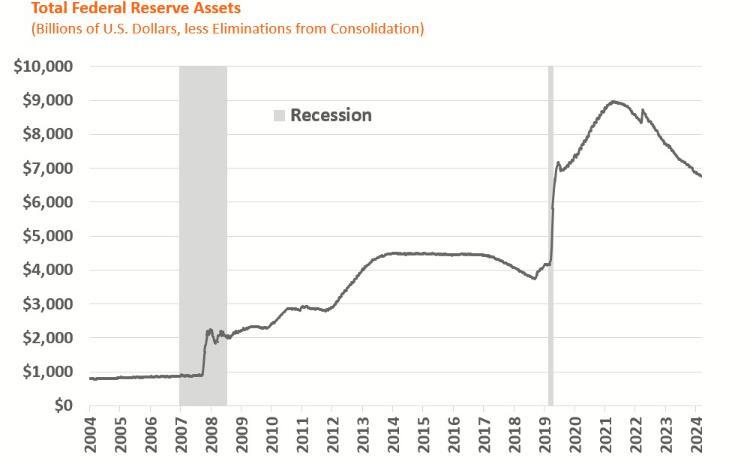
Similarly, during the COVID-19 recession, multifamily properties demonstrated their strength by maintaining overall positive rent growth, despite the challenges. These examples highlight why multifamily real estate is a solid, recession-resistant investment—reliable even when other markets falter. Read More
Risk Reduction Through Diversification
One of the key advantages of multifamily real estate is its built-in diversification. With multiple tenants across various units, your investment spreads income generation over a broad base, reducing the risk associated with vacancies or tenant turnover.
Beyond traditional rent, multifamily property owners can also generate additional income by introducing fees for pet ownership, covered parking, or laundry services, further diversifying and increasing revenue streams.
Tenant diversification adds another layer of security. Multifamily properties attract tenants from various sectors, which helps mitigate risks during economic downturns in specific industries. For example, if job losses occur in one sector, tenants from other industries—like healthcare, education, or technology—will still be able to pay rent, providing steady cash flow for property owners.
Geographic diversification also plays a critical role in risk mitigation. By investing in multifamily properties in different locations, you reduce exposure to economic downturns in any specific market.
A geographically diverse real estate portfolio ensures that your wealth remains secure, regardless of local economic shifts, and continues to grow over time.
Appreciation Potential: Forced and Natural Growth
Appreciation occurs when the value of a property increases over time, driven by market trends or improvements made to the property. In addition to natural market-driven appreciation, multifamily properties can also benefit from forced appreciation, where strategic improvements to the property—such as better management, upgraded amenities, or rent increases—drive up the value.
The S&P CoreLogic Case-Shiller Home Price Index shows that U.S. home prices have risen more than threefold from 2000 to 2025, reflecting an average annual appreciation rate of about 4.8%. This long-term growth demonstrates real estate’s ability to generate consistent value increases despite market fluctuations. Read More
Enhancing Value Through Forced Appreciation
In addition to natural market growth, investors can also increase the value of their multifamily properties through strategic improvements. This can include renovating units, upgrading amenities, or improving property management practices to increase tenant satisfaction and reduce vacancies.
The higher Net Operating Income (NOI) resulting from these efforts makes the property more attractive to future buyers, increasing its value independent of broader market conditions.
Tax Benefits for Multifamily Real Estate Investors
Beyond offering stability and long-term value, multifamily real estate provides a number of tax-saving opportunities. These benefits allow investors to minimize taxable income while maximizing their returns, creating long-term wealth and making the inheritance process more tax-efficient for future generations.
Cost Segregation
Cost segregation is an advanced tax strategy that allows investors to accelerate depreciation on certain property components, resulting in substantial tax deductions early in the ownership period. This strategy breaks down the property into shorter-depreciating components (like HVAC systems, appliances, and flooring) instead of relying on the traditional 27.5-year depreciation schedule.
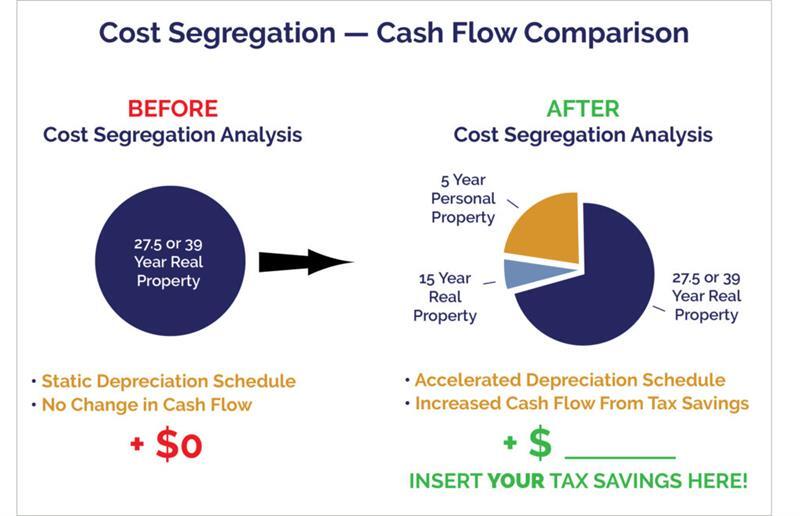
For Example:
For a $5 million apartment complex:
- Standard Annual Depreciation (over 27.5 years): ~$181,818
- By identifying $1 million in components for accelerated depreciation (via cost segregation), you can depreciate $200,000 in the first year alone.
- The remaining $4 million depreciated normally adds another $145,455.
- This gives a total first-year depreciation of $345,455, resulting in approximately $103,636 in tax savings (assuming a 30% tax rate).
Step-by-Step Depreciation Calculation
- Identifying Depreciable Components: In the example above, $300,000 of components (e.g., HVAC, appliances, flooring) can be depreciated over 5 years, while the rest of the property (land, structure) will follow the standard 27.5-year depreciation schedule.
- First-Year Depreciation: By depreciating those components over five years, the first-year depreciation for those $300,000 worth of components is $60,000 (300,000 ÷ 5).
- Tax Savings: With $92,727 in total depreciation, the investor can reduce taxable income by $27,818 (92,727 × 30% tax rate) in the first year alone.
Bonus Depreciation
Bonus depreciation further enhances tax planning, allowing investors to claim a large portion of depreciation in the first year of owning a property, accelerating the tax benefits of real estate ownership.
1031 Exchange
The 1031 exchange allows investors to defer capital gains taxes on the sale of a property if the proceeds are reinvested in another “like-kind” property. This enables multifamily investors to grow their portfolio without incurring immediate taxes on each sale, preserving more capital for reinvestment.

For example, an investor who sells a property for $5 million with a $1 million profit can defer taxes on that profit by reinvesting the proceeds in another like-kind property under a 1031 exchange, maintaining full access to the $1 million profit for further investment.
Stepped-Up Basis
When you pass your multifamily property to your heirs, they receive a stepped-up basis, meaning the property is revalued at the current market rate. This adjustment eliminates capital gains taxes on any appreciation that occurred during your lifetime.
For example, if you purchased a property for $500,000 and it appreciated to $1.5 million, your heirs would inherit the property at the $1.5 million value. They would only pay capital gains tax on any appreciation from that point forward, not on the $1 million gain that occurred during your ownership.
Tax Advantages and Wealth Preservation
Multifamily real estate offers exceptional tax benefits that high-net-worth investors can leverage to reduce their taxable income while building wealth. Strategies such as depreciation, cost segregation, and 1031 exchanges provide avenues for preserving and growing wealth, while minimizing tax burdens. These tools allow you to keep more of your returns, enhancing long-term wealth accumulation.
Multifamily properties not only provide a robust income stream but also offer the potential for forced appreciation through strategic property upgrades. Whether it’s improving property management or renovating individual units, multifamily real estate allows you to control the growth of your asset value.
Conclusion
The combination of tax strategies like cost segregation, bonus depreciation, 1031 exchanges, and a stepped-up basis makes multifamily real estate an exceptionally tax-efficient investment vehicle for wealth-building and legacy planning.
By leveraging these strategies, investors can maximize their returns, reduce their tax liability, and ensure that their wealth is passed down to future generations in the most tax-efficient way possible.
Chapter 3:Getting Started in Multifamily Real Estate for HNWIs
Understanding Your Investment Options
For seasoned investors, getting started in multifamily real estate is not a matter of ‘if’, but ‘how.’ Whether you seek full control of your investments or prefer a more passive approach, there are various ways to engage in multifamily properties.
From direct ownership to syndications, each option offers its own set of benefits tailored to different investment preferences and strategies.
Here’s a brief look at three common methods:
1. Sole Ownership
In sole ownership, you handle the entire down payment, property management, and financial responsibility. This gives you complete control and access to all income, appreciation, and tax benefits, but also comes with higher risk and responsibility.

2. Syndication
Syndication involves pooling capital with other investors to purchase larger multifamily properties, with the syndicator managing the deal. The syndicator acts as the general partner (GP), while investors (limited partners or LPs) provide capital and share in the profits.
- SEC Compliance Syndications must comply with SEC regulations, typically under Regulation D, allowing private offerings to experienced investors. The syndicator ensures compliance with securities laws, including proper disclosures, investor qualifications, and maintaining recordkeeping.
Benefits:
- Passive income without the management hassle.
- Diversification across multiple properties.
- Access to larger deals and professional management.
- Tax advantages such as depreciation.
3. Joint Venture
A joint venture allows multiple investors to pool resources and share the responsibilities and risks. Typically, one partner may focus on marketing while another handles property management, providing a balanced way to invest with shared risk.
Chapter 4: Your Legacy, Made Simple With WestKey Capital

You’ve seen how multifamily real estate can unlock lasting wealth, preserve your legacy, and provide powerful tax benefits. But what if you could access all of this without becoming a full-time real estate investor?
That’s exactly what WestKey Capital helps you do.
We understand that as a high-net-worth individual, your time is limited—but your financial goals are ambitious. That’s why we created a streamlined path to help you build wealth, protect your assets, and create a legacy, all while we handle the complexities behind the scenes.
How WestKey Capital Makes Legacy Building Simple:
- Curated Investment Opportunities
We handpick top-tier multifamily assets in high-growth U.S. markets through deep market research and due diligence. - 100% Hands-Off for You
We handle everything—from acquisition to management—so you earn passively while we do the work. - Maximize Returns with Smart Tax Strategies
Benefit from depreciation, cost segregation, and 1031 exchanges to grow and protect your wealth. - Real-Time Transparency
Stay updated with investor portals and regular reports—no guesswork, no surprises. - Tailored to Your Goals
We align each investment with your personal legacy vision—whether that’s early retirement, generational wealth, or financial freedom.
With WestKey Capital, You’re Not Just Investing—You’re Elevating Your Legacy
Conclusion: Your Journey to Building a Lasting Legacy with WestKey Capital

You’ve now learned how multifamily real estate can serve as the cornerstone of your legacy wealth strategy.. From understanding the power of investing in real estate to leveraging tax benefits and staying ahead of market trends, you now have the tools and insights to create a legacy that lasts for generations.
With the right strategy and the right partner, your wealth can grow beyond your lifetime, providing enduring financial security for your heirs. At WestKey Capital, we are committed to guiding you on this journey—helping you achieve your legacy goals with expert support, hands-off management, and unparalleled investment opportunities.
Ready to take the first step? Let’s start building your legacy today. Together, we’ll make sure your wealth outlives you and continues to empower future generations.
That’s what WestKey Capital delivers: Real estate investment with none of the hassle and all of the impact.